貝瑪林巴傳承
普賢密意總集靜忿百尊成就法
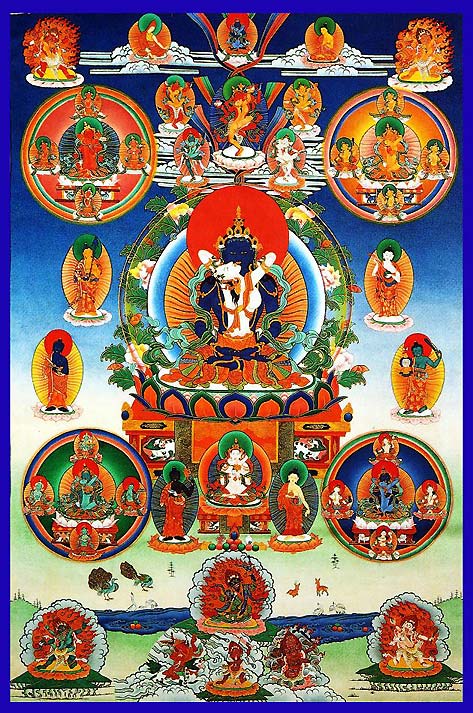
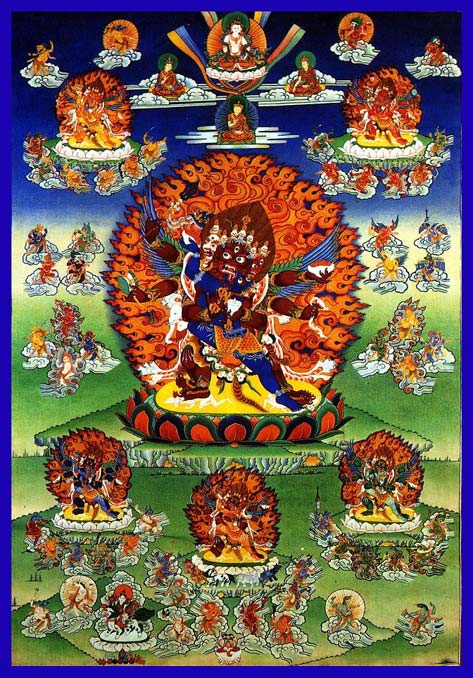
The Forty-Two Peaceful Deities The Fifty-Eight Blood-Drinking Wrathful Deities
This cycle of the Hundred Peaceful and Wrathful Deities is a treasure teaching of the Pema Lingpa lineage. It belongs to the Dzogchen cycle known as the Father: The Gathering of Samantabhadra’s Enlightened Intent. Within this cycle, the liturgy of the Peaceful and Wrathful Deities was revealed as part of the profound instructions that Guru Rinpoche once transmitted to Princess Pema Sal.
This teaching belongs to Atiyoga, the Great Perfection. The liturgy states that through practicing this Dharma, one may attain Buddhahood in this very life. If one is unable to attain unsurpassed awakening in this lifetime, then at the time of death, through this practice, one may be introduced to the innate awareness that has always been present within oneself, thereby immediately recognizing the nature of mind and becoming self-liberated.
If one is unable to be liberated through recognizing one’s own true nature, then during the bardo, when the Forty-Two Peaceful Deities and the Fifty-Eight Blood-Drinking Wrathful Deities appear, one may recognize them as one’s own yidam deities. Through this recognition, one will be guided and liberated by the yidam. Therefore, this practice is regarded as one of the most precious methods for guiding the deceased.
Within the maṇḍala of the Great Illusory Net, there are the Forty-Two Peaceful Deities and the Fifty-Eight Blood-Drinking Wrathful Deities, together comprising the Hundred Peaceful and Wrathful Deities. The Illusory Net clearly teaches that the body of each sentient being is itself the maṇḍala of the Illusory Net, and that the Peaceful and Wrathful Deities are fully present within one’s own body.
However, sentient beings are obscured by adventitious ignorance and fail to recognize the truth of the naturally self-appearing purity of their own nature. Clinging to deluded appearances as other than themselves, they continue to wander throughout the three realms of saṃsāra, with little opportunity for liberation.
When sentient beings have left behind their former body but have not yet taken up a future body, this state is known as the bardo of becoming. At that time, they drift upon a desolate and perilous path, tormented by fear, confusion, and various sufferings. Without refuge or support, they are in an extremely pitiable state.
If, at such a time, they receive the transference and guidance of the Peaceful and Wrathful Deities liturgy from the Dzogchen cycle Father: The Gathering of Samantabhadra’s Enlightened Intent, they may come to understand that all appearances and existence, saṃsāra and nirvāṇa, are primordially pure. Recognizing their own true nature, they can forever depart from the suffering of delusion and swiftly attain unsurpassed awakening. Therefore, one should truly cherish and make use of this rare and precious opportunity.
If one establishes a Dharma connection with this sublime treasure teaching for oneself and others, then at the time of death one will receive the blessings of the Guru and the protection of the yidam. Those of highest capacity may attain liberation in this very life; those of middling capacity may be reborn in a nirmāṇakāya pure realm; those of lesser capacity may once again obtain a precious human rebirth endowed with freedoms and advantages. Even those of the lowest capacity, by praying with faith through this Dharma for the blessings of the Guru, may avoid falling into the lower realms.
Therefore, for both the living and the deceased, this Dharma is an extraordinarily important, vast, and profound teaching, possessing inconceivable qualities and benefits.